Mockup gallery
Enter the password to continue.
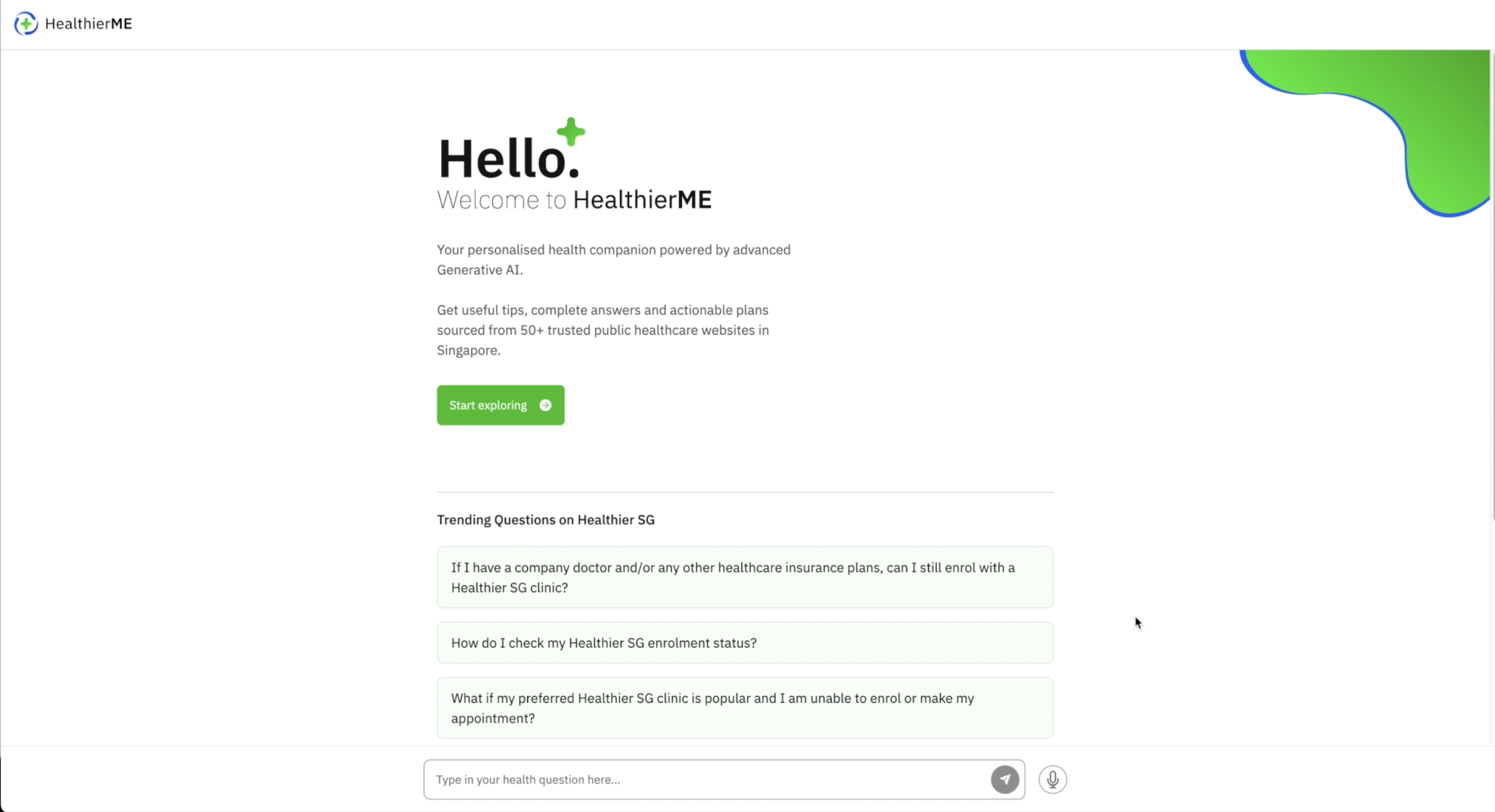
Citizens searching for healthcare information were bouncing between search engines, apps and hotlines, often landing on incomplete or hard-to-contextualise answers. HealthierMe is a Generative AI health companion built with the Ministry of Health, Synapxe and IBM to close that gap, powered by IBM watsonx.
There's a wealth of healthcare information spread across public websites and knowledge bases in Singapore, but search results are often irrelevant, incomplete, or hard for someone to map onto their own situation. A citizen's first attempt at a self-service app or search engine frequently leads to a second try, a third try, another app, or a call for support, well beyond the contact centre, into Healthier SG enrolment or a primary care physician.
The opportunity. Use generative AI to close that gap: aggregate trusted, local healthcare sources into one place, and answer citizens in plain language, in context, on the first try, with the potential for 30–40% operating cost efficiency, a 15% lift in NPS, and a 20% lift in workflow efficiency.
"How might we leverage generative AI to empower citizens to make more informed healthcare decisions?"
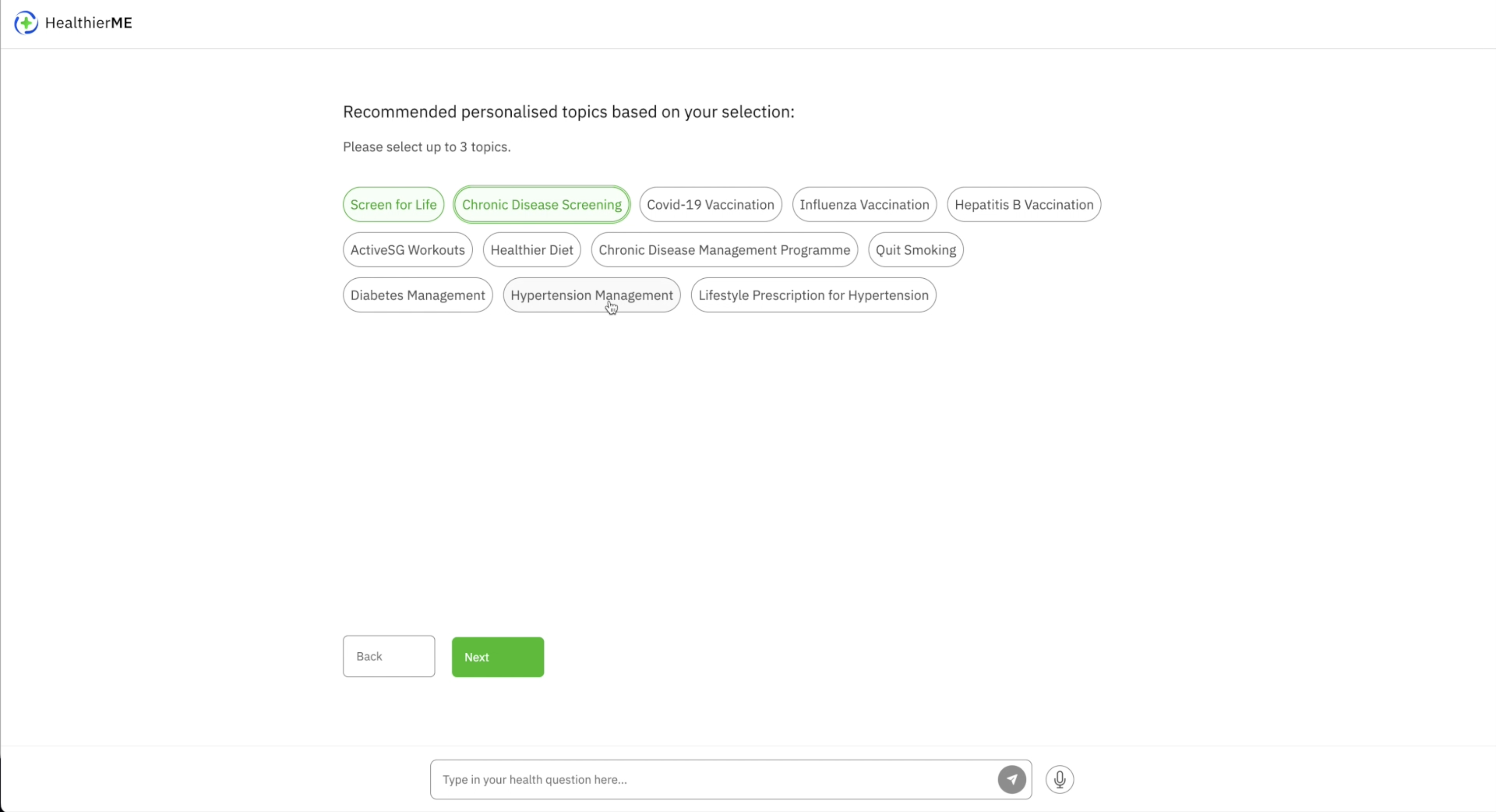
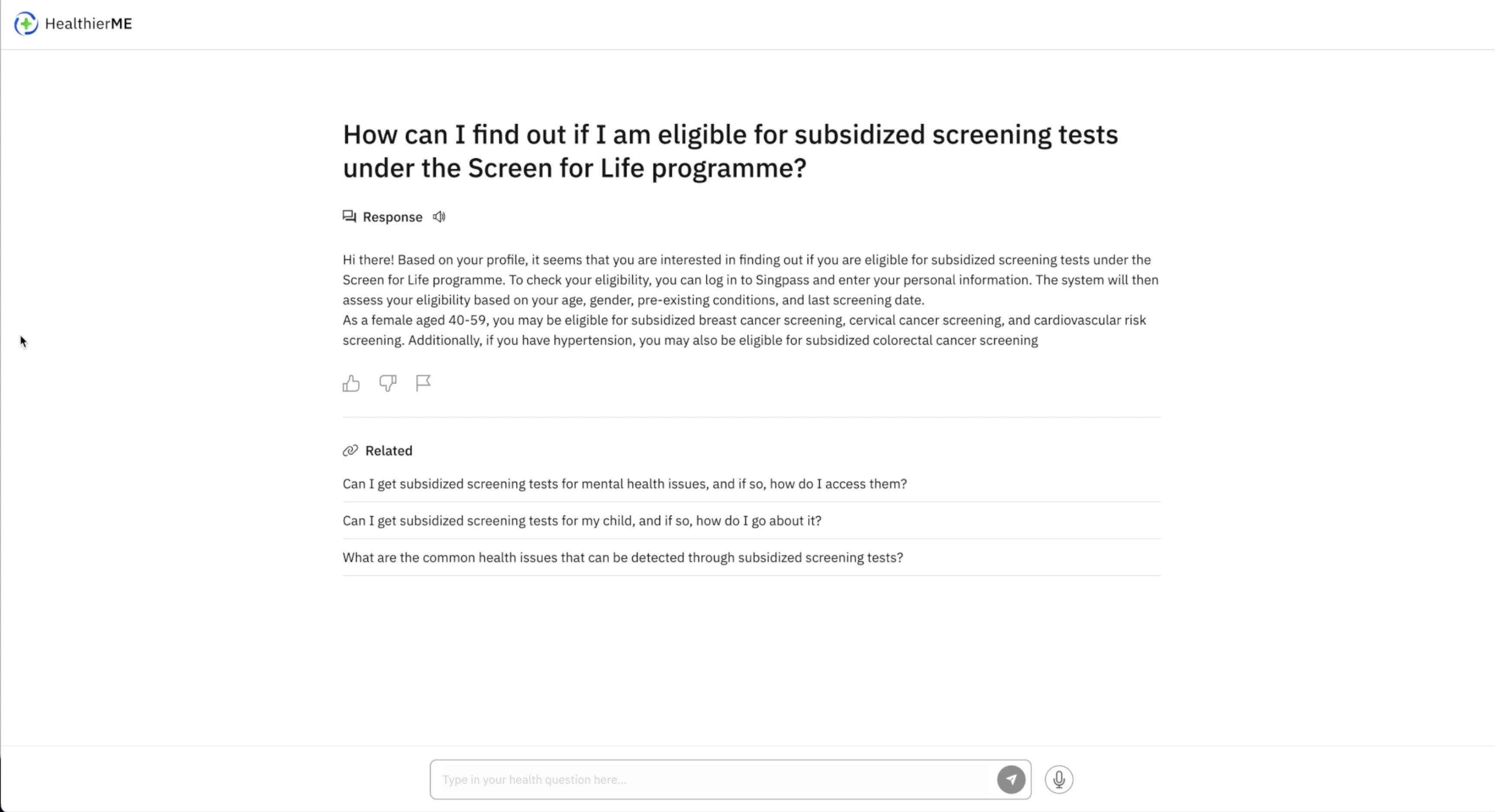
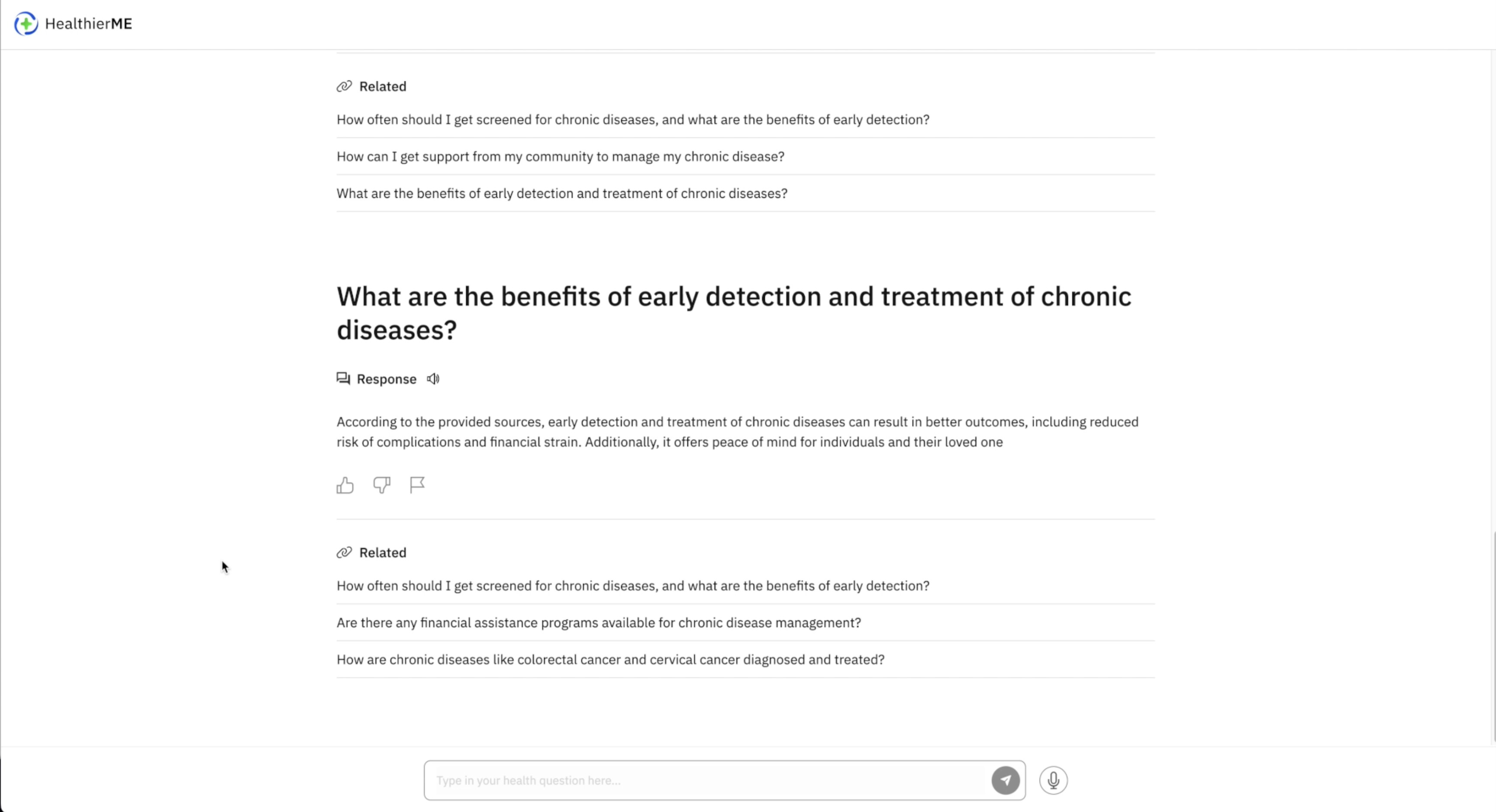
HealthierMe is a personalised health companion powered by generative AI, offering useful tips, complete answers and actionable plans sourced from 50+ trusted public healthcare websites, HealthHub, the Agency for Care Effectiveness, MOH, and more. Citizens can either type a healthcare question directly, or build a lightweight profile so HealthierMe can tailor its recommendations and follow-up questions to them.
Under the hood, Watson Discovery crawls and indexes the trusted source sites into a Milvus vector database; watsonx Assistant handles intent detection and routes the conversation; and watsonx.ai generates the answer itself, grounded in the retrieved content rather than the model's own general knowledge.
Synapxe, MOH and IBM framed the core question: how might generative AI help citizens make more informed healthcare decisions?
Refined the business opportunity, defined scope, and identified the solution architecture and co-create team.
Four two-week sprints, each ending in a playback: UI/UX flows, web crawling, backend integration, prompt engineering.
User testing, roadmap for adoption, knowledge transfer, and input into the business case for what comes next.
Design thinking facilitator
Ran the kickoff and discovery workshops that aligned MOH, Synapxe and IBM around the problem and the MVP's two primary use-cases.
UX & interaction designer
Designed the wireframes and UI flow, direct Q&A and profile-based recommendations, and shaped the two-day user testing methodology.
Research & visual designer
Synthesised the testing data into the business and technical success criteria, and translated the product into a clean, trustworthy interface.
Part A, head to head. Testers picked 2 questions from a list of 8, then found the answer using both HealthierMe and their own preferred search engine (Google, ChatGPT, Bard). We timed both, and asked which they preferred and why.
Part B, open exploration. Testers explored the MVP freely, then rated 7 statements on a 5-point scale across ease of use, quality of responses and follow-ups, and productivity potential.
From 27 testers across MOH, Synapxe and the Health Promotion Board, over 18–19 December 2023.
Beyond user perception, we measured the retrieval-augmented pipeline itself against five RAGAS metrics: answer relevancy (how relevant the answer is to the question), answer correctness (accuracy against ground truth), context precision and context recall (how well retrieval surfaced the right source material), and faithfulness, effectively a hallucination check, measuring whether the answer stayed grounded in the retrieved sources.
On Healthier SG AskGov questions with known ground truth, HealthierMe hit a 96% exact-match rate. On broader healthcare topics without ground truth, faithfulness and answer relevancy scored in the 0.7–0.9 range, with context precision (0.60 → 0.65) improving iteration over iteration as we refined the crawling, vector database and search retrieval steps.
Root causes. Conflicting or outdated information across sources; occasional hallucination; missing information where a source hadn't been crawled; and chunk relevancy issues, like returning a citation instead of the actual content.
Fixes explored. A domain-searching knowledge graph to rank sources by topic; sharper prompt engineering; re-ranking retrieved chunks by relevance; and testing a larger model (Llama 70B) for more nuanced pattern recognition, alongside streaming responses and a refactored backend to cut wait time.
A citizen can tap a speech button and ask their question aloud. IBM Watson Speech to Text converts it, HealthierMe answers as usual, and the citizen can play the response back in speech form too, using IBM's out-of-the-box "English Worldwide Medical Telephony" model.
The whole loop, speak, transcribe, answer, speak back, was scoped, built and tested in 7 working days, demonstrated against 2–3 representative questions.
MOH Healthier SG Task Group, assisting ambassadors answering public questions, and as a knowledge-retention tool for onboarding or crisis response.
HPB Chief Data Officer's Office, integrated into Healthy 365, using a citizen's existing step and activity data to shape its suggestions.
HPB Physical Activity & Healthy Ageing, embedded directly on HealthHub's own search bar, tailored by professional vs. resident profile.
Synapxe Healthier SG Tech Office, a helper tool for primary care physicians, alongside health coaching use-cases raised by HPB R&D.